Studio 4/03
The Aerotropolis
Ethan Zhang & Emma Tai
Studio Description
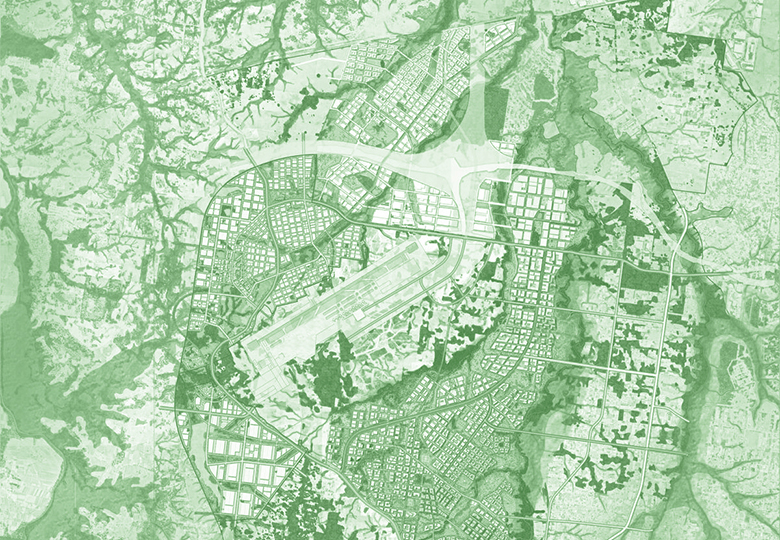
The Greater Sydney Commission has established a clear, overarching vision for Sydney – a Metropolis of Three Cities, Historically, Eastern Harbour City and Central River City have been the main focus on jobs, amenities, growth, and infrastructure in Sydney. The Aerotropolis presents a remarkable opportunity to rebalance Western Parkland City - a massive transformation across time and scale.
At around 11 square kilometers, the Aerotropolis is large, but as a system, it extends beyond the project boundary through different layers of the place. This Studio will utilise Geographic Information System (GIS) platform to investigate and understand the system, setting up urban design frameworks to protect and enhance important cultural and ecological space, providing for long-term infrastructure needs, and creating a sense of local ownership.
The Studio also encourages the student to drawing on both landscape knowledge and insights from other disciplines beyond the landscape architecture profession, investing yourself in rich historical/cultural contexts, technological thinking, ecological awareness, and intellectual nuances to develop imaginative landscape responses to issues as well as opportunities identified on site.
Studio Outcomes
- Orientation and Investigation: Students work closely with the studio lead, using the GIS platform to unpack spatial data to understand the challenges and opportunities, and respond to their research agenda. They will use hybrid mapping techniques to present their findings, together with other forms of drawings.
- Systemisation: through phase 1, students will extract findings, ideas, and spatial approaches to inform personal positions – translating site analysis into a well-considered landscape planning framework, from analytical observation to speculative proposition.
- Conceptualisation: Students will learn to work across scales, transfer, adapt, and iterate design principles from a large-scale concept to smaller-scale intervention areas.
Studio Leader/s
Ethan Zhang
Currently working at ASPECT Studios, Ethan is an experienced landscape architect and urban designer across a broad range of project types, from concept to delivery. With a global perspective, he has contributed to a variety of award-winning projects in Australia, China, Europe, and the U.S, demonstrating his capability to work at the highest quality across geographic boundaries and constraints. He has previously taught at UNSW, UTS, and RMIT, with a focus on landscape planning strategies.
Emma Tai
Emma Tai is a landscape architect currently working at ASPECT Studios. Over the past few years, she has acquired extensive experience from urban to landscape design projects across Australia, Hong Kong, and Saudi Arabia. Emma holds a master’s degree in landscape architecture from RMIT University, where she developed interest in ecological urbanism to design for spatial equity. Her major project claimed the TCL Student Prize in 2020.
Readings & References
Books
- Wall, Ed et al. The Landscapists : Redefining Landscape Relations. Oxford: John Wiley & Sons, 2020. Print.Jan Gehl, Life between buildings: using public space, Island Press 1971
- Billy Fleming: ‘Design and the Green New Deal’, places journal
- James Corner: ‘Terra Fluxus’ in Ch. Waldheim Landscape Urbanism Reader
- Corner, James. Recovering Landscape : Essays in Contemporary Landscape Architecture. New York: Princeton Architectural Press, 1999. Print.
- Ivers, B. Cannon. 250 Things a Landscape Architect Should Know. Switzerland: Birkhäuser, 2021.
- Cantrell, Bradley E., and Justine. Holzman. Responsive Landscapes : Strategies for Responsive Technologies in Landscape Architecture. London: Taylor & Francis Group, 2015.
- Scott, Emily E. “Infrastructure Inside Out.” Toward an Urban Ecology: SCAPE. The Monacelli Press, 2016
- Gehl, Jan, and Lord Richard Rogers. Cities for People. Berlin: Island Press, 2013.
- Dunne, Anthony, and Fiona Raby. Speculative Everything: Design, Fiction, and Social Dreaming. Cambridge: The MIT Press, 2013.
- Steiner, Frederick R., and Ian L. McHarg. Design with Nature Now. Ed. Frederick R. Steiner. Cambridge, Massachusetts: Lincoln Institute of Land Policy, published in association with the University of Pennsylvania Stuart Weitzman School of Design and The McHarg Center, 2019.
Websites
- https://www.hassellstudio.com/conversation/wianamatta-rising-charting-the-future-of-a-western-sydney-waterway
- https://www.hassellstudio.com/project/wianamatta-western-sydney-aerotropolis
- https://landscapeaustralia.com/articles/parkland-visions-designing-the-western-sydney-aerotropolis/
Schedule Thursday 1:15 pm - 7:15 pm in MSD 121
Need enrolment assistance?
Stop 1 provides enrolment and other support to Bachelor of Design, Bachelor of Environments and Melbourne School of Design students.