Design Thesis/10
Exchange
Mitchell Walker
Studio Description
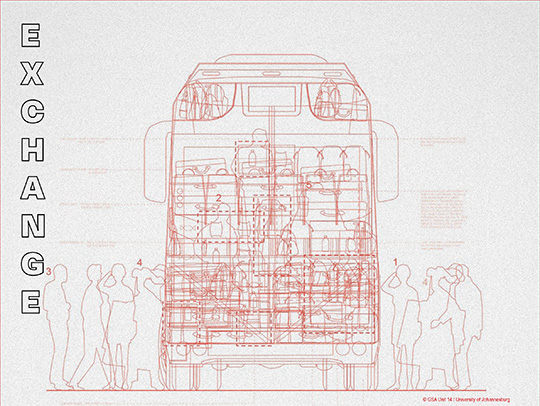
This studio will consider the expanded role transport hubs can play in broadening the conceptual understanding of the public sphere as one that is diverse and complex. Beyond an infrastructure project, we will consider the hub an important architectural site of intersection and exchange; of moving from one modality to another, of trajectories and timeframes, of formal and informal, of private and a multiplicitous public. We will explore, “…‘urban potential’, where ‘new modalities of public space may be experimented, [which] are the counter-spaces of the metropolis’ beyond the imperatives of logic and commodification” (Chatterjee, 2020). Using the program of the transport interchange as a jumping off point, this studio explores the idea of public space and questions the inherent politics in designing for ‘the public’.
Studio Outcomes
In this studio students will propose a new contextually relevant transport hub in a site that is known to them. Using ethnographic methods and the inscriptive practices of architecture, students will undertake a deep site analysis to understand local material cultures as well as networked socialities and economies to interrogate the issues highlighted above. They will be encouraged to draw on their own situated, culturally specific knowledges. The studio will include guest lectures and external critics from academia and practice including principal architects from Wardle.
Studio Leader/s
Mitch Walker is a designer and project leader at Wardle, with experience across large scale public, residential, commercial and healthcare projects. He has worked on the integration of transport interchanges within the public realm in Australia and the UK, having been part of the design team for Melbourne Metro, London High Speed Rail and Cross Rail stations. He is keenly interested in the idea of civic space and the potential of architecture to shape our relationship to the public realm.
Alex Biernacki is a designer leader at Wardle, working across commercial, residential, industrial and civic typologies. With an appreciation for detail, materiality and spatiality, his passion lies in the human scale experience that should be central to every architectural interaction. As an active silversmith and musician, Alex believes in cross disciplinary experimentation as a way to inform an enriched and expansive creative practice.
Readings & References
Office (ed), Tom Muratore (ed). The Politics of Public Space Vol 1-4. Office Publishing. 2020
Lucas, Ray. Anthropology for Architects: Social Relations and Built Environment. London: Bloomsbury Publishing, 2020.
Lucas, Ray. “Threshold as Social Surface.” In Surfaces: Transformations of Body, Materials and Earth, edited by Mike Anusas and Cristián Simonetti, 97-115. London: Routledge, 2020.
Mehrotra, Rahul. “Negotiating the Static and Kinetic Cities: The Emergent Urbanism of Mumbai.” In Other Cities, Other Worlds: Urban Imaginaries in a Globalizing Age, edited by Andreas Huyssen, 205-218. Duke University Press, 2008.
Mukhija, Vinit and Anastasia Loukaitou-Sideris, eds. The Informal American City. Cambridge Ma: MIT Press, 2014.
Psarra, Sophia. Architecture and Narrative: The formation of space and cultural meaning. London: Routledge, 2009.
Volk, Carmella Jacoby and Anat Messing Marcus. "Haptic Diagrams: From Cinematography to Architectural Performance." Journal of Architectural Education, 62 no. 3 (2009): 71-76.
Schedule Monday 6:15 pm - 9:15 pm MSD Bldg Room 118 and Thursday 6:15 pm - 9:15 pm MSD Bldg Room 125
Need enrolment assistance?
Stop 1 provides enrolment and other support to Bachelor of Design, Bachelor of Environments and Melbourne School of Design students.