C/03
'We're Glad You're Here!
Ben Waters
Studio Description
If you read last night’s Herald, you probably know about the two Viet brides, Thi Ba Watson and Huong Harty, both of whom are working in our factory. Twenty-two year old Thi Ba has worked here for nearly a year, Huong started 5 weeks ago. It was Thi Ba’s idea that Huong should work at Fletcher Jones.
There are Italians, Greeks, Yugoslavs, Lebanese, Egyptians, and Turks working in the factory. English lessons are held twice a week after work, and Thi Ba is encouraging Huong to join the class.
We all join in saying a sincere word of welcome. In the words of Mr. Fletcher Jones’ oft-sung song, ‘We’re glad you’re here.’ … And the same goes for the Italians, Greeks, Yugoslavs, Lebanese, Egyptians, and the Turks.
- Note to Fletcher Jones Staff, 1962
Introduction
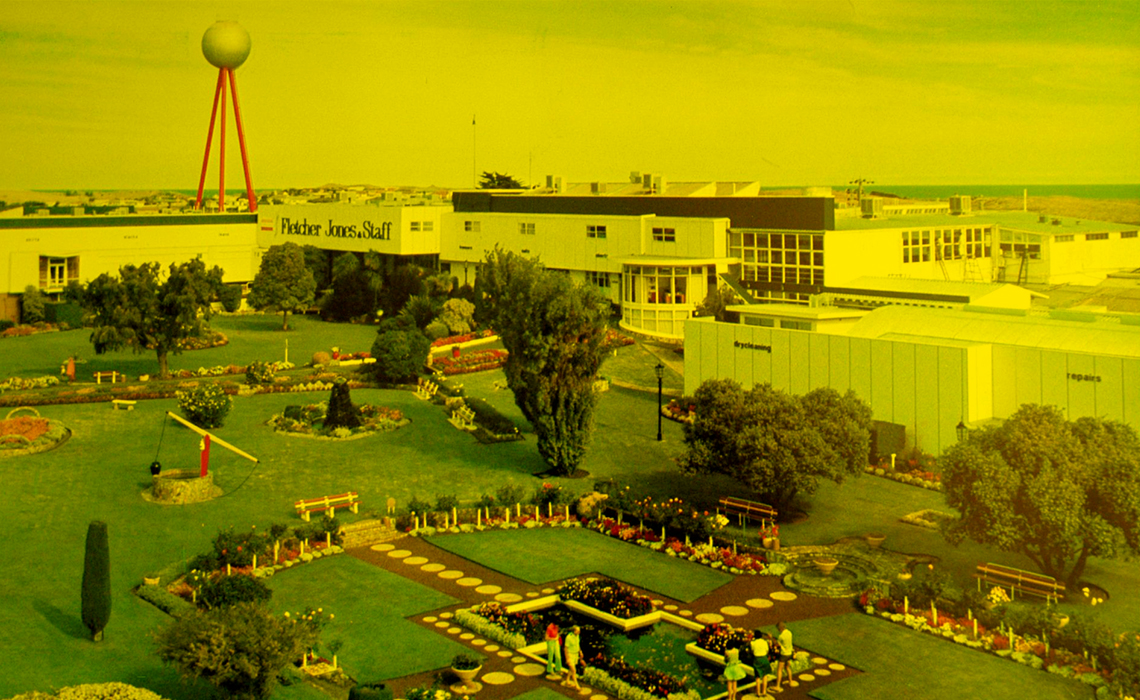
The Fletcher Jones factory site in Warrnambool, coastal south-west Victoria, holds memories of a remarkable past of people and politics. Topped with a surreal silver ball and surrounded by a heritage garden, the saw-tooth, fibro-clad sheds housed 1,000 workers of Fletcher Jones and Staff, all with a share in the company. Through the 1980s, the era of industrial protectionism ended, and since the 1990s, industry and manufacturing have gradually left the city.
Embedded in the ethos of the people working together at the FJ site was an optimism for the future. The silver ball that sits aloft the site, visible from most parts of the city, represents a vision of tomorrow that Fletcher Jones dreamed of since visiting the New York World’s Fair in 1939.
Decades on, the famous FJ high-kitsch garden survives. Although its topiary, sculptures, and giant flower baskets are ruled by neatness and control, the garden represents a lightness of spirit and a social space that was cared for and loved by the people of FJs and the city. Beyond the garden, many of the spaces inside the factory’s various buildings lie empty and in need of repair.
Studio Outcomes
A More-than-Human-Garden
When establishing the much-loved garden, Fletcher Jones may not have anticipated the destructive structures lurking within anthropocentrism. His dream, though, was to establish an environment that supported the well-being of people working on the site through a connection with the nature of place.
Through a field trip to the site, we will conduct two key surveys. Firstly, a study of the garden through notation—mapping, indexing, and recording the layout, objects, and plant species existing in the garden.
As part of the studio design project, we will ask: In a new era, can parts of the FJ site ecology grow larger and more complex for the benefit of all species, whose needs for new habitat are real? Can the garden be supported and advanced to establish new connections with culture and Country?
A Decorated Shed
In the second key survey on our field trip, we will conduct a study of the various FJ facades. Over the decades, there have been many iterations of graphics, signage, and decorations adorning the sheds. Unfortunately, these original graphics have largely been erased and lost. In addition to tracing the history of the modernist graphics and façade systems, as a studio group, we will capture the existing facades using 3D scanning technologies, including LiDAR laser scanning and photogrammetry.
This will be an opportunity for you to learn a new technique in studying this cultural heritage site using advanced digital 3D systems. Importantly, it will form the basis for a key part of the studio project—The Decorated Shed. This will be a design task to reimagine the facades of FJs, using the digital data as a departure point for an elevation-based design project.
A Future Factory
A central part of the studio project will be to imagine future workshops, community, and making spaces within some of the underutilized buildings on the site. We will trace the evolution of making, technology, and workshop spaces on the site, and work with local community stakeholders to plan speculative future factory spaces.
We will ask: What can really be done within the existing economic, social, and political parameters of this project? What barriers need to be overcome to have all the spaces on the site flourish? What environmental, engineering, and ecological adaptations can be imagined to steward a future of productive work, cultural exchange, and biodiversity?
Studio Leader
Ben Waters is an architect and founder of S-I Projects – a design agency working at the intersection of technology, ecology and cultural heritage. Ben is also principal at Waters Architects, a regional based architecture practice working alongside communities to transform spaces into thriving environments.
Readings & References
Thinker, tailor, Tesla, sphere, The Monthly, Jock Serong
The Fabric of a Dream - The Fletcher Jones Story
Maintenance Architecture, Hillary Sample
Architecture of the Well-Tempered-Environment, Reyner Banham
More-than-Human - Andres Jaque, Marina Otero Verzier, Lujcia Pietroiustgi
Learning from Las Vegas, Robert Venturi, Denise Scott Brown
Creative Ecologies, Helen Frichot
A Cautious Prometheus - A Few Steps Toward a Philosophy of Design, Bruno Latour
ABPL90437 Design Studio C is an Early start subject. The Studio Ballot will be held online at the beginning of O-week, opening at 9am on Monday 15th July and closing at 9am on Tuesday 16th July. The outcome of Studio Allocation will be announced on Canvas before the end of Thursday 18th July. There will be preparatory online learning work to be completed during this period. Teaching begins with an all day, in person, compulsory Symposium Day in Laby Theatre (L108), David Caro Building at 9am on Friday 19th July.
Schedule:
Thursday 3:15pm-6:15pm in MSD 237
&
Friday 9am-12pm in MSD 241
Off-Campus Activity:
Warnambool, Victoria
Need enrolment assistance?
Stop 1 provides enrolment and other support to Bachelor of Design, Bachelor of Environments and Melbourne School of Design students.