E/11
Orthosis
Guillermo Rojas-Alfaro
Studio Description
Architectural works are unsettled. They are subject to changing environments, obsolescence, destruction. Buildings get damaged, they get old, they are lived. Nothing lasts forever, and nothing remains the same. We can assume that stone will last longer than timber, but at some point, both will be gone. Being in such a dynamic city as Melbourne, it seems evident that buildings decay, yet still, we approach our creations as something relatively stable and enduring. We think, design, and represent buildings in an ideal state, pristine and unaffected by the environment or people. And when they are affected, we discard them.
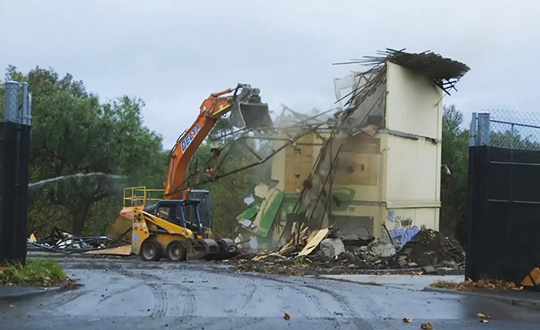
The Sutton Street Housing Towers are a testament to the fragility of this way of thinking. Facing demolition, this mid-century housing project is the home for hundreds of families that will be displaced in the coming years and a haven for a community that will be destroyed along with the buildings ─this without considering the environmental impact of demolishing a concrete structure of 21 stories in height.
Studio Outcomes
This studio prompts you to challenge the faith of these towers and retrofit these structures to tackle the issues that elicit their demolition plans in the first place ─lack of open spaces, poor ventilation and insulation, limited common facilities, etc. You will design an orthosis, a supporting structure that, without substantially altering the building’s fabric, will extend its life and improve the lives of the people inhabiting it.
You will work in four temporal intervals. First, its past, as one the Housing Commission’s “high-rise elevator flats” developments. Second, its present, as a space in decay to be surveyed, interpreted and valued, but also as a space that homes a community that is your client. Third, its near future, which includes your proposal as a response to the preexisting building and its urban context. And fourth, its mid future, where your proposal will be implemented and built in stages, so the life of the community is affected as little as possible.
This studio has adaptive reuse and retrofit studies as a foundation. It relies on historical sources and archival research, the thorough survey and drawing of the buildings’ fabric and the critical interpretation of the needs of a community in its urban context to define the type of intervention you will develop over the semester.
Studio Leader
Guillermo Rojas-Alfaro is an architect, researcher, and academic with fourteen years of experience leading design studios in Australia, Europe and South America. He holds an MSc in Sustainable Heritage from The Bartlett UCL and recently submitted his PhD at the MSD. Before moving to Melbourne, Guillermo was the Director of the Cultural Heritage Graduate Diploma and an Adjunct Assistant Professor of the MArch PUC. As an independent architect, his work on adaptive reuse and retrofit of historic buildings has been internationally published, awarded, and showcased in various international exhibitions, including the Venice Biennale.
Readings & References
Aigwi, I. E., Phipps, R., Ingham, J., & Filippova, O. (2021). Characterisation of Adaptive Reuse Stakeholders and the Effectiveness of Collaborative Rationality Towards Building Resilient Urban Areas. Systemic Practice and Action Research, 34(2), 141–151. https://doi.org/10.1007/s11213-020-09521-0.
Austin, R. (1988). Adaptive Reuse: Issues and Case Studies in Building Preservation. New York: Van Nostrand Reinhold.
Bloszies, C. (2012). Old Buildings, New Designs. New York: Princeton Architectural Press.
Cramer, J., & Breitling, S. (2007). Architecture in Existing Fabric. Birkhäuser. https://doi.org/10.1515/9783034609449.
Douglas, J. (2006). Sustainable Adaptation. In Building Adaptation. https://doi.org/10.1016/b978-075066667-
Han, B. (2017). The scent of time (D. Steuer, Trans.). Oxford, England: Polity Press.
Hill, J. (2019). The architecture of ruins. London, England: Routledge.
Rojas-Alfaro, G. (2018). Rojas-Alfaro, G. Re-Founding the Industrial Past. The International Committee for Conservation of the Industrial Heritage Conference.
Rojas, G., Karakiewicz, J., & Selenitsch, A. (2021). From survey to representation. An experiential approach to the knowledge and portrayal of the built heritage. Mimesis JSAD, 1. (pp. 9-26). https://doi.org/10.56205/mim.1-1.1
Solari, F., & Rojas-Alfaro, G. (2024). Integrity and Authenticity. In L. Makhloufi (Ed.), Tangible and Intangible Heritage in the Age of Globalisation (pp. 177–200). Cambridge, UK: Open Book Publishers. https://doi.org/10.11647/OBP.0388UNESCO. (n.d.). Heritage Sustainability. Retrieved January 31, 2024, from https://en.unesco.org/creativity/development-indicators/dimensions/heritage
Wong, L. (2023). Adaptive reuse in architecture. Basel, Switzerland: Birkhauser.
ABPL90439 Design Studio E is an Early start subject. An in-person Studio Presentation Day event will be held in the Laby Theatre (L08), David Caro Building from 1pm-2pm on Tuesday 16th July followed by one-hour Q&A Session with Studio Leaders and Subject Coordinators in the MSD building. The Studio Ballot will be held online at the beginning of O-week, opening from 3pm Tuesday 16th July and closing at 3pm Wednesday 17th July. The outcome of Studio Allocation will be announced on Canvas before the end of Friday 19th July. There will be subject preparatory online work to be completed during this period before the semester commencement.
Schedule:
Monday 12:00pm-3:00pm in MSD 142
&
Monday 3:15pm-6:15pm in MSD 142
Need enrolment assistance?
Stop 1 provides enrolment and other support to Bachelor of Design, Bachelor of Environments and Melbourne School of Design students.