Basin
Basin
Dayne Trower & Simona Falvo
Studio Description
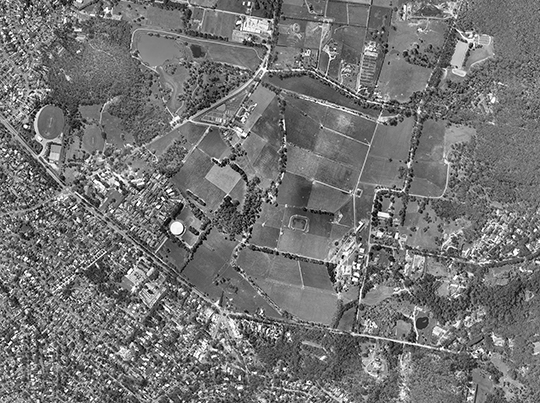
Located 31km east of the Melbourne CBD, The Basin is a small town nestled within the picturesque foothills of the Dandenong Ranges.
The primary geological feature is The Basin flood plain, a meandering linear water territory that is central to the formation of the suburban boundaries. Despite appearances, the flood plain has been significantly modified by human intervention, controlling the flow of water for agriculture and for protection from flood and fire.
At the periphery of the flood plain, is land held by the longest established institution in The Basin community, the Salvation Army. 219 acres of land was purchased, collectively referred to as ‘Eden’, in 1897. ‘Eden’ was founded with the vision that the therapeutic value of farming could help rehabilitate young offenders. Over time, a collection of ‘homes’ were constructed on the site and today, the Basin Recovery Centre of the Salvation Army provides support, recovery and rehabilitation services.
Along with this significant site, The Basin also comprises a series of peculiar, yet quintessentially suburban, intersections with buildings including The Basin Theatre, the Romanian Seventh-Day Adventist Church and a main shopping strip that Robin Boyd would have referred to as an exemplar of “cultural cringe”.
However, there is much to be celebrated in these characteristics of inconsistency clear in the vernacular of The Basin, and more broadly, many of the suburbs operating on the outskirts of Melbourne. Here, what reigns is an idiosyncratic pragmatism that challenges the elusive architectural paradigms of proportion, truth, arrangement and beauty.
Studio Outcomes
Students will initially be required to undertake a variety of research and design-based projects through site visits, mapping and model making to establish an understanding of their own design processes and how these can be shaped in response to the context of The Basin site and its broader surrounds. Students will then be given a brief, which they can expand upon and challenge, for a mid to large scale project relating to what has been discovered throughout the preliminary weeks of the semester.
Students must be able to:
- Conceptualise and engage in rigorous research through design to open the potential for experimentation and innovation.
- Communicate ideas and designs verbally, visually and textually through a range of investigative media.
- Research with enhanced appreciation of theoretical, environmental, social, historical, cultural and technical contexts in relation to the activity of architecture.
- Examine architecture’s responsibility in the regional realm and its potential, from the micro, human and macro scales.
Studio Leader/s
Dayne Trower
Dayne is an architect and director of Trower Falvo Architects. Prior to starting his own practice, Dayne worked on a number of significant local and international projects, predominantly with Sean Godsell Architects, including the 2014 M Pavilion. Dayne is also trained in design and has worked alongside renowned Australian designer, Brian Sadgrove. Dayne is especially interested in design that is site and culturally specific, developed through a rigorous process of examination and research and his work, which has been widely published and exhibited, inherently explores these concepts.
Simona Falvo
Simona is an architect and director of Trower Falvo Architects, having completed her Master of Architecture at the Melbourne School of Design. She graduated with first class honours and has studied abroad at the University of Stuttgart and University of Gothenburg. Simona has had extensive experience in multiple award-winning architecture practices in all project stages, from initial concept design, documentation and project delivery.
Readings & References
- Selected excerpts from ‘Fire on the Hill, Flowers in the Valley’, Coxhill, R.
- Selected excerpts from ‘The Australian Ugliness’, Boyd, R.
- ‘The Agency of Mapping: Speculation, Critique and Invention’, Corner, J.
- ‘Intersections’ in ‘Furniture, Structure and Infrastructure’, Bertram, N.
- ‘A Provisional Theory of Non-Sites’ and selected articles in ‘Robert Smithson: The Collected Writings’, Flam, J. (ed.)
- Selected excerpts from ‘The Sublime and the Beautiful’, Burke, E.
- ‘Splitting and Doubling: Gordon Matta-Clark and the Body of Sculpture’, Wagner, M.
- ‘Subtraction’ in ‘Buildings Must Die: A Perverse View of Architecture’, Cairns, S. and Jacobs, J.
Additional readings and reference material will be provided throughout the semester.
Schedule:
Monday 6pm-9pm, MSD 140
Thursday 6pm-9pm, MSD 140
Need enrolment assistance?
Stop 1 provides enrolment and other support to Bachelor of Design, Bachelor of Environments and Melbourne School of Design students.