Domesticity Inside Out
Domesticity Inside Out
Dijia Chen
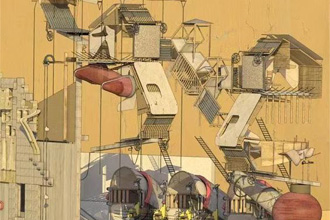
Studio Description
The arrangement and configuration of domestic spaces throughout history have often privileged single-use, inflexible scenarios of inhabitation. This is despite life, work, and entertainment constantly evolving, intertwining, and overlapping in contemporary times. What if the concept of "home" were to be reinvented? How might traditionally private spaces be reimagined through co-living? How can we redefine domesticity amidst post-COVID transformations, rapid urban renewal, and an increasing housing crisis?
In this studio, you are challenged to reimagine collective housing, creatively intersecting with a secondary public program of your choice-be it a library, art gallery, vertical farm, theater, or stadium-in metropolitan contexts. Your secondary program should serve as a driving force to break down spatial labels and embed flexibility and uncertainty into your exploration of domesticity, innovatively challenging cultural norms on work-life balance, privacy, gender roles, and/or child/elderly care.
We will kick off the semester by analyzing unconventional domestic spaces in fictional worldviews, as seen in movies, anime, and video games. Drawing inspiration from these sources and after conducting case studies on collective housing from around the world since the early 20th century, you will select a site in Melbourne, Berlin, Boston, or Hong Kong (TBD) for your housing proposal. Throughout the semester, you will be encouraged to test experimental and radical ideas while also receiving practical training in understanding spatial efficiency, programmatic arrangement, and materiality. The studio will meet twice a week for desk crits, workshops, and pin-up sessions. In addition to lectures by the studio leader, guest lectures by practicing architects and professors will be arranged as needed.
Studio Outcomes
The project requires consistent iterative work and will result in a coherent, resolved, but also radically experimental proposal to be presented through multiple 2-dimensional and 3-dimensional representational approaches, including but not limited to detailed orthographic drawings, analytical diagrams, collages/renderings, and physical model(s). Students will
1. Learn to tackle housing projects from the perspectives of the individual user, the commissioning institutions, and the city at large.
2. Develop a comprehensive understanding of typologies of aggregation, urban morphologies, spatial sequencing, and programmatic integration.
3. Develop skills of making that include the understanding of the structural, constructive, and spatial characteristics of materials, issues of circulation, lighting, and ventilation.
4. Develop analytical skills aimed at examining and rendering the familiar world unfamiliar.
Studio Leader/s
Dr. Dijia Chen is an architectural historian/theorist/architect/curator with educational and professional backgrounds in Shanghai, Berlin, and Central Virginia. She has taught at the University of Virginia and James Madison University in the USA. Her research mobilizes theories in visual culture, transcultural studies and curatorial studies and encompasses a diverse array of interconnected subjects. Informed by her background, Dijia’s studio teaching encourage students to incorporate knowledge from their respective cultural, ethnic, or geographical communities into the formal and spatial specifics of their design. Besides preparing students for the workforce, her studios serve as foundations for their diverse self-expression and proactive social engagement.
Readings & References
Hanna Arendt, “Vita Activa and the Human Condition,” “Man: A Social or Political Animal,” and “The Durability of the World” in The Human Condition, (Chicago: The University of Chicago Press, 1998), 7–11, 22–26, 136–138.
Peter Rowe, Modernity and Housing, (Cambridge: MIT Press, 1995).
Reyner Banham, "A Home is Not a House", Art in America, Vol. 2, (1965), 70-79.
Tatiana Bilbao, A House is Not Just a House: Projects on Housing (2018).
“Mon Oncle ”, directed by Jacques Tati , 1958 (111 min)
Schedule:
Tuesday 3pm-6pm, MSD 241
Friday 3pm-6pm, MSD 240
Need enrolment assistance?
Stop 1 provides enrolment and other support to Bachelor of Design, Bachelor of Environments and Melbourne School of Design students.