Expanding Ecologies
Expanding Ecologies
Francesco Stassi
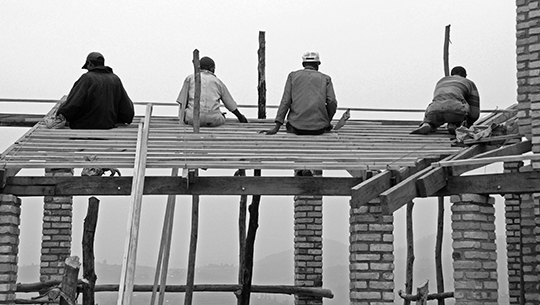
Studio Description
What is the role of design professionals in fostering sustainable, context-sensitive development in the Global South? This studio explores low-carbon design strategies in Rwanda, examining how design choices impact environmental, cultural, social, and economic factors, with a focus on resource efficiency and innovation in low-infrastructure contexts.
Students will design an Early Childhood Development Center on a site bordering an informal settlement and a wetland in Kigali. Through this project, they will investigate how design decisions - ranging from material selection to the negotiation between public and private spaces - can drive broader social transformation.
Reflecting on architecture’s role in informal settlements, projects will address challenges such as accessibility, public space quality, and environmental risks. The design will define the boundary between new and existing conditions while creating sensory-rich spaces for children and the community. By responding to topography, microclimate, and cultural context, the studio fosters sustainable and impactful design solutions.
Studio Outcomes
The students will explore appropriate technologies and material supply chains in East Africa, assessing their projects' economic feasibility and environmental sustainability while developing skills in active research and physical modeling. A critical understanding of the local context—including power imbalances and the ethics of practicing in the Global South—will guide their design approach, ensuring meaningful social and environmental impact.
Simulating a professional environment, the students will engage in all design phases, from pre-design to construction documentation, requiring strong design resolution and graphic representation. Prototyping and material exploration will be key to translating ideas into tangible solutions. Students will craft scaled models and prototypes of building elements using earth and bio-based materials, assessing performance and evaluating environmental and social impact.
Through workshops, mini-lectures, and discussions with local stakeholders, students will explore how design and construction strategies can address real-world challenges while fostering sustainable development and improving community livelihoods.
Studio Leader/s
Francesco Stassi
Francesco is a Lecturer and Creative Practitioner at the Faculty of Architecture, Building and Planning of the University of Melbourne and a registered architect in Italy and Rwanda, with extensive experience in socially engaged architecture in East Africa. He is the Director and Partner at ASA Studio - Active Social Architecture, an architecture firm based in Kigali, Rwanda. His research interests focus on appropriate technologies, cost-efficiency, participatory processes, and sustainable design for projects in the Global South.
Readings & References
Butera, F., Adhikari, R., & Aste, N. (2014). Sustainable building design for tropical climates: Principles and applications for eastern Africa. UN-Habitat.
Dyson, A. (2023). Building materials and the climate: Constructing a new future. United Nations Environment Programme.
Folkers, A., & Van Buiten, B. A. C. (2019). Modern architecture in Africa: Practical encounters with intricate African modernity. Springer International Publishing.
Lepik, A. (Eds.). (2014). Afritecture: Building social change. Hatje Cantz.
Minke, G., & Minke, G. (2009). Building with earth: Design and technology of a sustainable architecture (2nd and rev. ed ed.). Birkhauser-Publishers for Architecture.
Page, A., & Memmott, P. (2021). Design: Building on country. Thames & Hudson.
Yeang, K. (1995). Designing with nature: The ecological basis for architectural design. McGraw-Hill.
Zumthor, P. (2021). Atmospheres: Architectural environments. surrounding objects (10th ed.). Birkhäuser.
Schedule:
Monday 3pm-6pm, MSD 141
Thursday 3pm-6pm, MSD 141
Off-site Activities:
Regional Victoria: Yandoit - Kyneton
Need enrolment assistance?
Stop 1 provides enrolment and other support to Bachelor of Design, Bachelor of Environments and Melbourne School of Design students.