Flats
Flats
Kate Finning
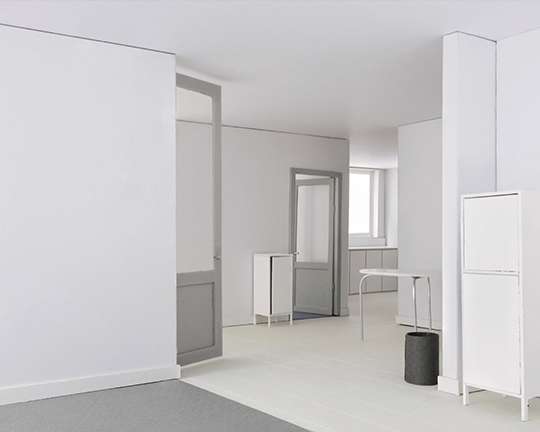
Image: Rooms with diagonal connections by Eddie Guo and Tyler Song, S2 2024.
Studio Description
Among the ideas that dominate architectural discourse, use of the basic elements of architecture: columns, doors, walls, windows, beams, and pilasters seem to have slipped away from the focus of the architect's expertise. So too pursuits such as facade composition, room arrangement and material expression, ideas that preoccupied architects for the majority of the discipline's history have receded, to be replaced by positivist and pseudo-scientific pursuits. We have not recovered from the salvation doctrine and scientific claims of the modernist project.
Instead, the studio aims to equip students with the tools and literacy to use architectural elements with precision: Is a square room in a dwelling more adaptable than a rectangular room? What criteria should determine the placement of a door? What is the effect of where a window sits within the depth of a wall? Does a deeper beam in a trabeated structure give more hierarchy to an opening or less? The questions the studio will be concerned with relate to the material reality and art of building.
Studio Outcomes
Students will work in pairs on a project comprising two blocks of flats: one existing and one proposed. The project will begin through the close study of exemplar domestic floor plans underlined by the conviction that the architect’s task in housing is a clear spatial determinacy with an indeterminacy of use. To this end, our projects will begin with the room.
The second half of semester will shift the focus to the volume and facade. Here the expression of the building will follow an understanding of existing architectural languages as well as the resolution of a construction detail. Our volumes will attempt to frame the spaces around the building and propose a balanced facade composition that responds to existing building languages.
Projects will be documented through physical models and orthogonal drawings.
Studio Leader
Kate Finning is an architect practicing in Melbourne. She recently co-edited the publication Five Good Swiss Plans (Quart Publishers, 2025) with Guillermo Fernández-Abascal.
Readings & References
- * Bates, S. “Living from the centre.” In Papers 3: Sergison Bates architects, 108-121. Lucerne:
Quart Publishers, 2016.
* Beigel, Florian and Philip Christou.“Room Non-Room: Peter Märkli Atelierhaus
Weissacher.” Quaderns d arquitectura i urbanisme, no.265 (2013): 36-41.
* Diener, Roger and Martin Steinmann, The House and the City. Basel: Birkhauser Verlag,
1995.
* Kelly, Meggie. Dark Alcoves, Hidden Niches, and Cozy Corners. Los Angeles: Oso Press,
2012.
* Mosayebi, Elli and Christian Inderbitzin, “La porte, une échelle de l’habitat” [The Door, a
Scale of Habitat], Matières, 13 (2016): 86-97.
* Rowe, Colin and Robert Slutzky. “Transparency: Literal and Phenomenal...Part
II.” Perspecta, Vol. 13/14 (1971): 287-301
Schedule:
Tuesday 3pm-6pm in MSD 238
Friday 3pm-6pm in MSD 238
Off-site Activities:
Contact Handbook
Need enrolment assistance?
Stop 1 provides enrolment and other support to Bachelor of Design, Bachelor of Environments and Melbourne School of Design students.