How Virtual Becomes Real
How Virtual Becomes Real
Associate Professor Alberto Pugnale
Studio Description
“How Virtual Becomes Real” explores design-to-construction workflows for shell and spatial structures, integrating analogue and digital processes, tools, and techniques.
Taking Greg Lynn’s provocation that “no two blobs are identical” and that “blobs cannot be reduced to a typological essence” as a point of departure, the studio invites students to investigate free-form, lightweight, large-span architectural-structural bodies: forms that usually do not conform to conventional methods of construction or typological classification. The core question guiding the studio is: “How can free-form architecture be designed through a performance-oriented approach to acquire tectonic and material qualities?”
Students will engage with strategies for form-finding, geometry rationalisation, and structural optimisation to explore the transition from virtual concept to constructed form.
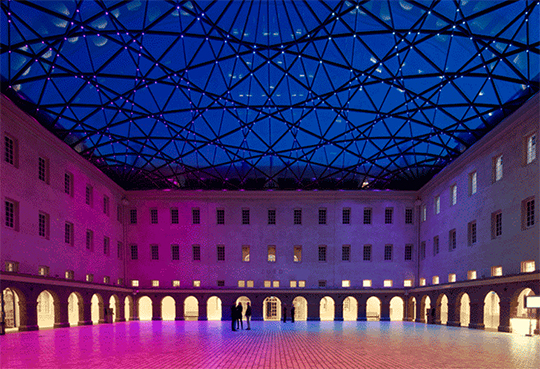
The brief concerns the adaptive reuse of a historic building, requiring the integration of shell and spatial structures to cover an internal courtyard and activate the surrounding spaces for public events. Students are expected to synthesise their computational design and tectonic investigations into a coherent architectural proposal.
Studio Outcomes
Concept Design: Students will engage with structural form-finding, parametric design thinking, and construction automation techniques through abstract design exercises and precedent analysis. Working individually, students will develop a concept design that demonstrates the ability to: (1) generate and explore architectural-structural forms using Rhinoceros and form-finding tools in Grasshopper; (2) develop Grasshopper scripts for design automation, including surface discretisation and panelling; (3) conduct FEM analyses using Karamba; (4) produce models using laser cutting, 3D printing, and other relevant fabrication techniques.
Resolved Design: Students will refine their design proposals, focusing on building performance and tectonics. By the end of the semester, students are expected to: (1) communicate design propositions through diagrams, renderings, and computational design workflows; (2) present their work to an external panel of practitioners; (3) design and prototype a shell or other spatial structure at a range of scales (1:200 to 1:1).
Foundations in computational design thinking, and competency in Rhinoceros and Grasshopper, are preferred prerequisites.
Studio Leader/s
A/Prof Alberto Pugnale is an architect and Associate Professor in Architectural Design at ABP, and Co-Director of the Advanced Digital Design + Fabrication (ADD+F) Research Hub. His research spans computational design, optimisation, AI-based methodologies, and the digital reinterpretation of historical precedents. He explores the intersection of theory and practice through design, fabrication, and structural/acoustic performance. He has received major awards, including the IASS Hangai Prize (2007), IASS Tsuboi Award (2023), and first prize in the IASS Design Competitions (2023 and 2024). He has taught internationally and serves on editorial boards including the “Nexus Network Journal” and “International Journal of Space Structures”.
Readings & References
Adriaenssens S., Block P., Veenendaal D., Williams C., Shell Structures for Architecture: Form Finding and Optimization, Routledge, 2014.
Engel H., Structure Systems, 3rd edition, 2007 (1967).
Holgate A.,The Art of Structural Engineering. The work of Jörg Schlaich and his Team, Axel Menges, Stuttgart, London, 1997.
Nerdinger W., Frei Otto. Complete Works: Lightweight Construction - Natural Design, 2005.
Peters B. and De Kestelier (Eds), Computation Works: The Building of Algorithmic Thought, Architectural Design, March/April 2013.
Tedeschi A., AAD Algorithms-Aided Design, Le Penseur, 2014.
https://www.albertopugnale.com/2021/02/13/the-shape-of-wine-2020/
https://www.albertopugnale.com/2018/06/18/how-virtual-becomes-real-2018/
https://www.albertopugnale.com/2017/09/03/how-virtual-becomes-real-2017/
Further references will be provided during the semester.
Schedule:
Monday 3pm-6pm in MSD 238
Thursday 4pm-7pm in MSD 141
Off-site Activities:
Need enrolment assistance?
Stop 1 provides enrolment and other support to Bachelor of Design, Bachelor of Environments and Melbourne School of Design students.