Radical Suburbs: Box Hill
Radical Suburbs: Box Hill
Paul Walker
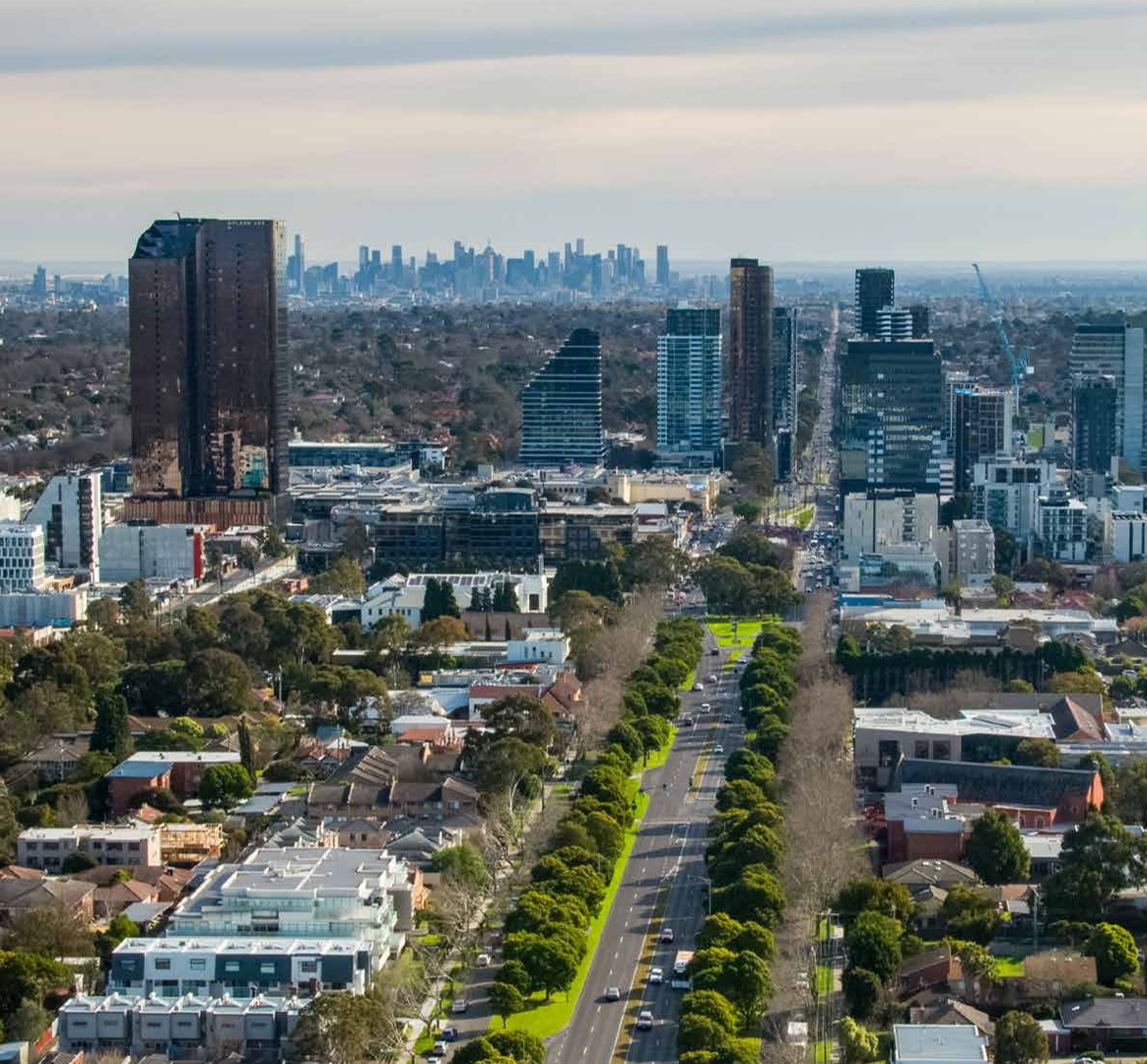
Studio Description
Radical Suburbs takes its title from a recent book Amanda Kolson Hurley which examines suburban communities in American cities which drastically departed from the common view of the suburbs as cultural wastelands and places of conformity. How can we take these lessons from urban history and rethink the architecture of suburbia anew? In this studio we will consider the Suburban Rail Loop, a major state transportation initiative, as an opportunity to consider how our suburbs could be transformed.
Box Hill is our test ground. Box Hill is the principal activity centre of the City of Whitehorse. It is a rapidly developing suburban centre, with the highest concentration of high-rise buildings in the Melbourne metropolitan area outside the CBD. Ethnically, it is very diverse, with large concentration of Asian businesses and food outlets. It is a major node on the Lilydale train line; its role as a transportation centre will dramatically expand with the building of the SRL.
Studio Outcomes
Foregrounding the transformative potential of the new Suburban Raul Loop stations, each student in the studio will develop a local scale strategic design vision within the Box Hill area. An architectural project tapping into that vision will then be proposed and resolved. The strategic vision can be a development framework or masterplan supported by well-documented research of relevant precedents and case studies sourced from Melbourne or elsewhere. The final architectural outcome can be drawn from a wide range of building typologies – small, medium, or large-scale architectural interventions, community and/or leisure facilities, innovative and inclusive medium density housing, local transport-associated infrastructure that supports cycling, shared EVs etc. Completely new programs associated with the urban reach of the Suburban Rail Loop can also be proposed.
Studio Leader/s
Paul Walker is a professor of architecture in the Melbourne School of Design. His research is about twentieth century architecture in Australia & NZ, and about museum architecture in colonial and post-colonial contexts. Recent publications include ‘The Multifunction Polis: an urban idea and its end’, in Miao & Yigitcanlar, eds, Routledge Companion of Creativity and the Built Environment (2024); Amanda Achmadi, Paul Walker & Soon-Tzu Speechley, eds, Architectural Encounters in Asia Pacific: Built Traces of Intercolonial Trade, Industry and Labour, 1800s-1950s, (Bloomsbury, 2024); & Paul Walker, John Andrews: architect of uncommon sense (Harvard Design Books, 2023).
Readings & References
Architecture Australia 110: 4 (July/August 2021) issue edited by Rory Hyde devoted to suburbia
Tom Avermaete & Janina Gosseye, Urban Design in the 20th Century: A History, Zurich: gta Verlag, 2021
Robin Boyd, The Australian Ugliness, Melbourne: Text, 2002 (first published 1960)
Robert Bruegmann, Sprawl: a compact history, Chicago: University of Chicago Press, 2005
Janina Gosseye & Tom Avermaete, eds, Acculturating the shopping centre, London: Routledge, 2019
Dolores Hayden, Building Suburbia: green fields and urban growth, 1820-2000, New York: Pantheon Books, 2003
Amanda Kolson Hurley, Radical Suburbs: experimental living on the fringes of the American city, Cleveland: Belt Publishing, 2019
Leandro Medrano, Luiz Recaman & Tom Avermaete, eds, The New Urban Condition, New York: Routledge, 2021
David Nichols, The Bogan Delusion, Mulgrave: Affirm Press, 2011
Kelum Palipane & Iderlina Mateo-Babiano, ‘Spatio-Temporal Alterities: Multiculturalism in Transport’ Hubs, in F Neuhaus , ed, Cultures,Communities and Design, AMPS Proceedings 30, 2023: 180-192
Peter Rowe, Making a Middle Landscape, Cambridge, Mass.: MIT Press, 1991
Schedule:
Monday 1pm-5pm in MSD 241
Thursday 12pm-2pm in MSD 241
Off-site Activities:
TBA
Need enrolment assistance?
Stop 1 provides enrolment and other support to Bachelor of Design, Bachelor of Environments and Melbourne School of Design students.