Studio 40
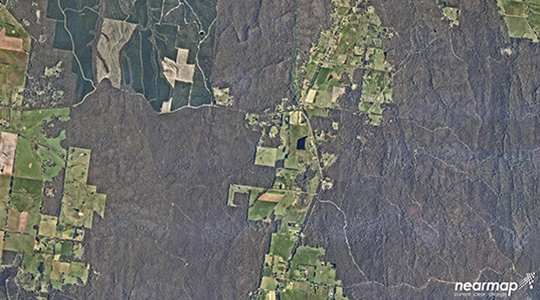
The Field - an utopian post-colonial future, Victoria, Australia, 2027
Rochus Hinkel | SENSES + PROCESS
This studio is available to students enrolled in ABPL90142 Studio C, ABPL90143 Studio D, and ABPL90115 Studio E.
Studio Description
Can we imagine a Utopia that creates a post-colonial social and political framework and overcomes the concept of land as commodity, inspired by indigenous concepts of relationship to country? Could a re-introduction of pre-settlement biodiversity, to a return to local food production, a re-thinking of community, establish an utopian and futuristic response to the challenges we face? Can a return to an holistic understanding of country, country as in all species, non-human and human, as practiced in the more than 60.000 years old indigenous aboriginal culture, help us to tackle our contemporary crises, from climate change and a system of continuous growth to the extinction of species and the industrialization of our food production?
The Field is a design studio that intertwines a physical and analog context, with all its histories and stories, its cultural context and societal connections, with a design studio that inhabits, explores and collaborates in the virtual, digital environment.
Through an investigative research process, following a series of seminars and presentations, students will develop an understanding of the potential of the site in order to develop an alternative model for an utopian future. Taking into consideration multiple aspects, broadly described as the social and the cultural future, including various perspectives and roles this location could play: from the non-human to the human, from the the economical to the educational, from the entrepreneurial to the philanthropic.
The studio is located on a rural site close to Daylesford, the site will be available to students in multiple ways, including through 360 degree panoramas and virtually through point cloud scans.
Guest lectures and critics will include Prof. Hélène Frichot, MSD; Michael Fragstein, Büro Achter April, www.8apr.de, Germany; Brett Leavy, Virtual Songlines, Australia, as well as shared studio sessions with arc/sec, University of Auckland.
Studio Outcome
Students are asked to imagine future design scenarios that address our current challenges, ranging from the collapse of our environmental systems to the extinction of species, to overconsumption, overproduction and social justice. Hence the program will have to address multiple scenarios, ranging from biodiversity, shelter, food production, to education and events, all supported through an architectural infrastructure.
Within the design studio students will develop projects that address a variety of functions, from large scale infrastructure and networks, to small scale interventions and insertions. Students will imagine how a variety of uses, functions, programs which allow for the ‘layering’ of temporal and seasonal events as well as permanent structures and infrastructures.
The studio will focus on communicating and developing ideas and concepts through narrative approaches, allowing to draw attention to aspects of architecture that are in other formats often forgotten or difficult to communicate, including atmospheric, ephemeral and temporal moments and situations. Presentations will include time-based narratives and virtual environments.
The studio will take part of the ARS ELECTRONIC festival for electronic art in 2020, the world leading event for digital art and experiments. Students will receive additional support by the NExT Lab, Melissa Iraheta and Tony Yu, as well as by the arc/sec Lab at the University of Auckland.
Mid-semester review will be in week 5!
The ability to use 3D modelling software, preferable Rhino, is a pre-requisite!
Studio Leader
Rochus is Associate Professor for Architecture and Design at MSD since January 2020. Rochus has been teaching in architecture, interior design and industrial design, previous positions include Professor of Artistic Design at OTH Regensburg, Germany, and Professor of Interior Design and Furniture Design at Konstfack University of Arts, Craft and Design, Stockholm.
Projects of his practice have been published and exhibited nationally and internationally, including Monument, Wallpaper, Design Report, Ottagono, Bauwelt, amongst others.
Since 2005 his research and practice concentrates on experimental and artistic explorations and installations focusing on the various environments humans inhabit, interact with and experience. This includes the private and the public realm, the urban and the rural, the analog and the digital. In 2020 he is the recipient of the Curatorial Research Fellowship by the SIDA Foundation and David Roche Foundation for his digital craft project 'The Doppelgaenger'.
Readings & References
Links:
- Cooperation partner: Lab for Digital Spatial Operations, The University of Auckland, https://www.arc-sec.com
- Exhibition partner: The world largest media arts festival Ars Electronica 2020 - Festival for Art, Technology, and Society: https://ars.electronica.art/keplersgardens/
- Teaching partner: NExT Lab, The New Experimental Technology Lab, MSD, https://msd.unimelb.edu.au/maker-spaces/next-lab
Literature:
- Jazairy, El Hadi & Ghosn, Rania (2020) Geostories: Another Architecture for the Environment. New York, Barcelona : Actar
- Preview: https://issuu.com/actar/docs/geostories
- Dja Dja Wurrung Clans Aboriginal Corporation, (2014) Delhkunya Dja - Dja Dja Wurrung Country Plan, 2014-2034. Retrieved from http://www.djadjawurrung.com.au/wp-content/uploads/2015/11/Dja-Dja-Wurrung-Country-Plan.pdf
- Frichot, Hélène (2018). Creative Ecologies: Theorizing the Practice of Architecture (pp. 17-45). USA : Bloomsbury. Retrieved from https://ebookcentral.proquest.com
- Gammage, Bill (2011). The Biggest Estate on Earth: How Aborigines made Australia. Sydney, Melbourne, Auckland : Allen & Unwin
- Olóriz Sanjuán, Clara (2020). Landscape as Territory: A Cartographic Design Project, New York, Barcelona : Actar Preview https://issuu.com/actar/docs/landscape_as_territory
- Pascoe, Bruce (2014). Dark Emu. Broome : Magabala
Schedule 12:00-15:00 Tuesdays and Fridays
Need enrolment assistance?
Stop 1 provides enrolment and other support to Bachelor of Design, Bachelor of Environments and Melbourne School of Design students.